
Studies
This page provides an overview of current and completed research projects conducted in our lab.On-going Studies
Our current studies investigate how sleep, dreaming and
mental health interact across development and adulthood.
Dreamscape Study
Exploring the Dreamscape: The Impact of Antidepressants on Dream Neurophysiology and ContentSleep disturbances and altered dreaming are common in major depressive disorder (MDD). Patient reports suggest that these symptoms are further influenced by antidepressant treatment.
Despite the close relationship between sleep, dreaming and mental health, little is known about how changes in sleep neurophysiology, subjective dream experiences and mental health are interconnected during antidepressant treatment.
The Dreamscape Study combines high-density polysomnography, a serial awakening paradigm, sleep and dream diaries and clinical assessments to investigate how antidepressant treatment shapes sleep architecture, dream experiences and psychological well-being in individuals with depression compared to unmedicated healthy controls.
Sleep P Study
Sleep neurophysiology as a window onto adolescent mental healthAdolescence is a period of both opportunity and vulnerability. In the teenage years, individuals make great strides in their social, emotional and cognitive development, preparing for their roles as emerging adults.
However, adolescence is also a period characterized by significant difficulties for many teens, and a number of mental health disorders have their onset during this time.
If we want to improve existing interventions and prevention approaches to mental health problems in youth, it is critical to understand the neurobiological mechanisms associated with mental health and vulnerability to mental illness.
This longitudinal project studies the sleeping brain using EEG in conjunction with self-report measures of sleep, providing a unique opportunity to understand neural function in health and disease.
Sleep Subtypes Study
Sleep Subtypes in Adolescent Depression: Sleep Physiology and TreatmentAdolescence is unique biological milieu and studies from adults cannot be generalized to adolescents.
Depression typically has its onset during adolescent development. Studying a disorder at its onset presents an opportunity to understand the etiology of a disorder.
Complaints of disrupted (insomnia) or excessive (hypersomnia) sleep are common among adolescents with major depressive disorder (MDD).
Previous studies have not addressed whether these two sleep subtypes in adolescent depression manifest different neurophysiology, clinical course or responsiveness to intervention. The current study addresses these questions.
Completed Studies
These studies have contributed to our understanding of sleep, development and mental health.Sleeping Twins Study
The Genetics of Sleep and Cortical Development in AdolescenceMeasuresSleep EEG
MRI
MRS
Cognitive Function
Depressive Symptoms
Actigraphy
PublicationsMarkovic, A., Achermann, P., Rusterholz, T. et al. Heritability of Sleep EEG Topography in Adolescence: Results from a Longitudinal Twin Study. Sci Rep8, 7334 (2018). https://doi.org/10.1038/s41598-018-25590-7
Adolescence is a critical period in development, characterized by rapid biological, cognitive, emotional and social changes. Interacting with these processes, is sleep, which is also in flux during this period.
Given the importance of sleep during this developmental period, the aim of this study was to unravel the genetic and environmental contributions to sleep, brain development, and cognition using a twin study design.
Two longitudinal assessments, six months apart, were conducted in monozygotic and dizygotic twins aged 12 to 14 years.
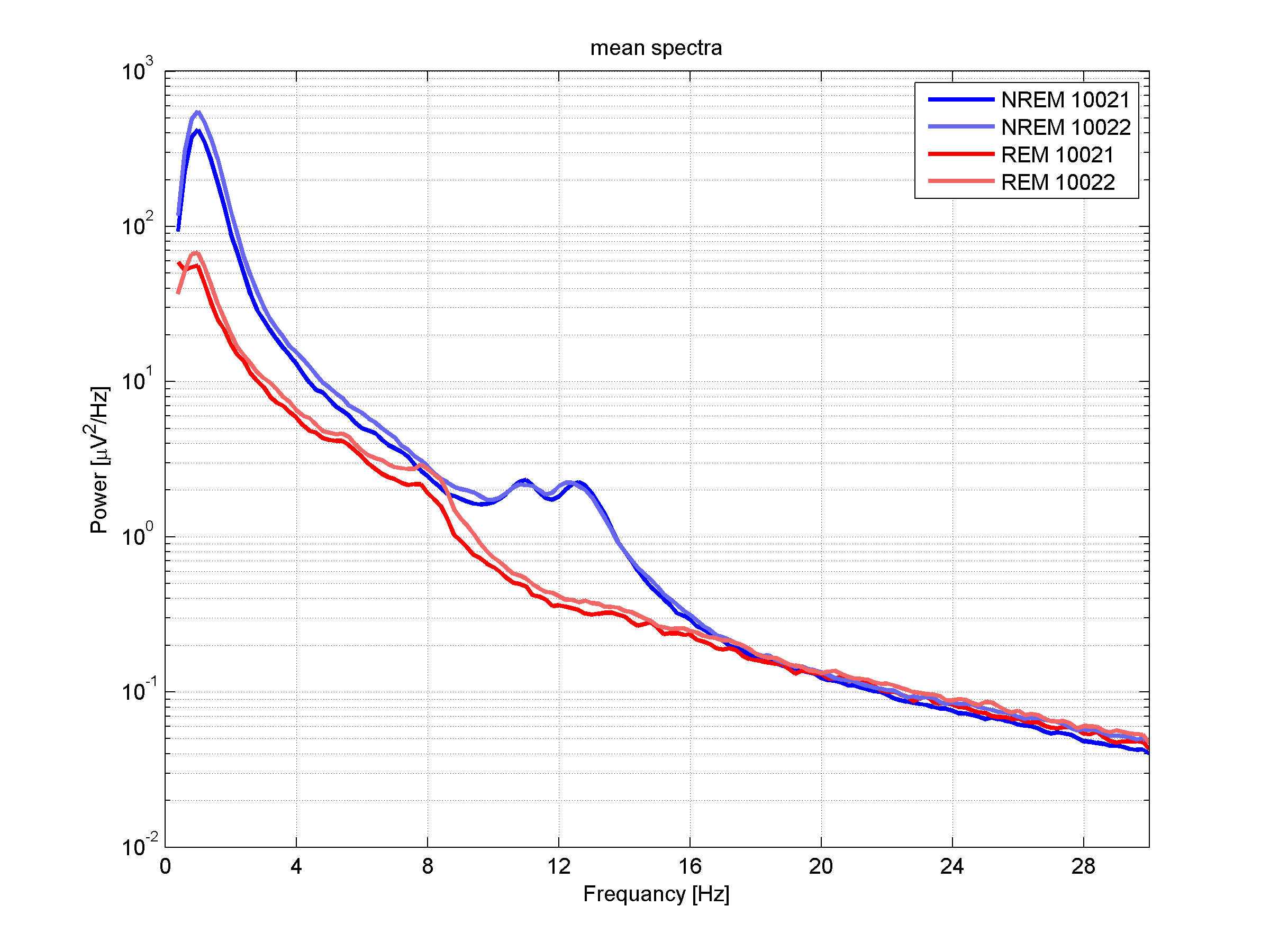
NREM and REM spectra of a pair of identical (Monozygotic) twins
Aims:
Quantify the degree to which concurrent changes in brain structure, cognition, and sleep physiology observed during adolescence are due to common or unique genetic and environmental factors.
Quantify the heritability of sleep at two longitudinal time points six months apart.
Examine whether sleep duration in the intervening time between assessments shows high heritability and is predictive of the changes in sleep, brain structure and cognition.

NREM and REM spectra of a pair of fraternal (Dizygotic) twins